At the time of writing, the FTC antitrust trial against Meta is about to commence (Vanian, 2025). Whether this will eventually lead to the breakup of Meta and its divesting of Instagram is undecided, but it is clear that the state of the social media ecosystem is entering a new level of public attention and scrutiny, especially in the age of quickly evolving AI technology and the social problems it induces. It is worth asking: What should the automated online public sphere look like after the potential breakup of Meta?
In Frank Pasquale's 2020 book The New Laws of Robotics, he suggested that social media should re-introduce the human expertise of journalism into the current "black box" of feed algorithm and automatic content moderation, and take the responsibility of media, in order to create a healthier environment for public discourse (Pasquale, 2020).
However, one could easily imagine the consequence of such shift in platform policy: accusation of censorship and manipulation, accompanied with a wave of users leaving the platform for other spaces that align more with their values, as evidenced in the 2022 conservative user migration to Truth Social, a platform launched by Donald Trump in protest of Twitter's ban on his personal account (Dolan, 2024). Such fragmentation creates large disjoint online social spheres based on users' values, which is even more undesirable than having echo chambers created by algorithms on a centralized platform.
To realize Pasquale's vision without such negative impact, a fundamental change in the social media ecosystem is unavoidable. Campaigning for the breakup of the company he once helped create, Facebook co-founder Chris Hughes suggested in his opinion on The New York Times in 2019 that an agency should be set up after the breakup of Facebook, in charge of not only protecting privacy, but also of guaranteeing basic interoperability across these separated platforms (Hughes, 2019). Such "basic interoperability" between separate social media services, regardless of its actual implementation, can be seen as a first step towards a more public future of social connect-ability, one that's based on open protocols, instead of closed platforms.
With the rollout of Threads on 2023, Meta itself also seems to embrace this vision with its support of sharing content to the "fediverse" (Instagram-n.d), which is a fully decentralized scheme of social media that, for years, has been a refuge for users dissatisfied with centralized platforms' policy on user privacy, feed algorithms, and toxic environments. In 2019, Twitter also started a research initiative on decentralized social media, which later became Bluesky, run by an independent public benefit company of the same name. These projects, despite being still in early stage of development, demonstrated a plausible open future of social network, allowing more actors to participate, providing user with greater autonomy, and recognizing diverse values.
In this essay, I will first introduce the motivation and basic design of existing decentralized social networks. Then, I will explore how these schemes address the issues of centralized social media in terms of data privacy, feed generation, and content moderation, with a particular focus on the opportunities for realizing Pasquale's vision of a desirable automated social sphere through respected journalistic expertise and human-AI collaboration. Lastly, I will identify the lessons that can be learned from decentralized social media as a remedy for the current reality.
Introduction to Decentralized Social Media
Decentralized social media is a style of social network architecture that uses distributed infrastructure for the integral social media services, such as identity provisioning, data storage, feed generation, and content moderation (Roscam Abbing et al., 2023).
Motivation
Centralized social networks, such as Facebook and Twitter, have concentrated control over users' personal and sensitive data, requiring users' consent and trust, and put users in a vulnerable position (Jiang & Zhang, 2019).
Moreover, the centralized control over modern society's essential social functions of networking, information distribution, and content moderation, causes concerns for the social network giants' unchecked power of social influence (Roscam Abbing et al., 2023), and questions about their abilities to properly address issues induced by their products, especially at the current scale (Gillespie, 2020).
In order to provide the foundation of solutions to these problems on a technical level, multiple paradigms of decentralized social media have been proposed, aiming to decentralize the various services of social networks to different degrees. These paradigms often involve open standards and protocols, to ensure the interoperability while maintaining their distributed nature (Roscam Abbing et al., 2023).
Examples of Decentralized Social Media
Fediverse
Federated social media is characterized by the distributed data storage, identity provisioning, and content moderation on individual "instances" of servers. The instances are interoperable to each other through "federation", based on the underlying ActivityPub protocol, so that users can discover and build network across multiple instances.
The resulting federated network of social network services is referred as the fediverse, with a variety of application being built on top, such as Mostodon (for Twitter-like microblogging), WriteFreely (for blogging) and PeerTube (for video streaming) (Caelin, 2022).
Some centralized social medias have also implemented the ActivityPub protocol, and start federating with the existing fediverse instances. One prominent example is Threads, Meta's relatively new microblogging service, which is interoperable with the fediverse (Instagram-n.d?).
Blockchain-based
Blockchain-based decentralized social networks incorporate blockchain technology, which serves as a common state for distributed infrastructures (Schneider, 2019).
The most important motivation behind the use of blockchain technology in OSNs is its potential of distributed monetization of content moderation and recommendation using cryptocurrencies and smart contracts (Jiang & Zhang, 2019).
AT Protocol
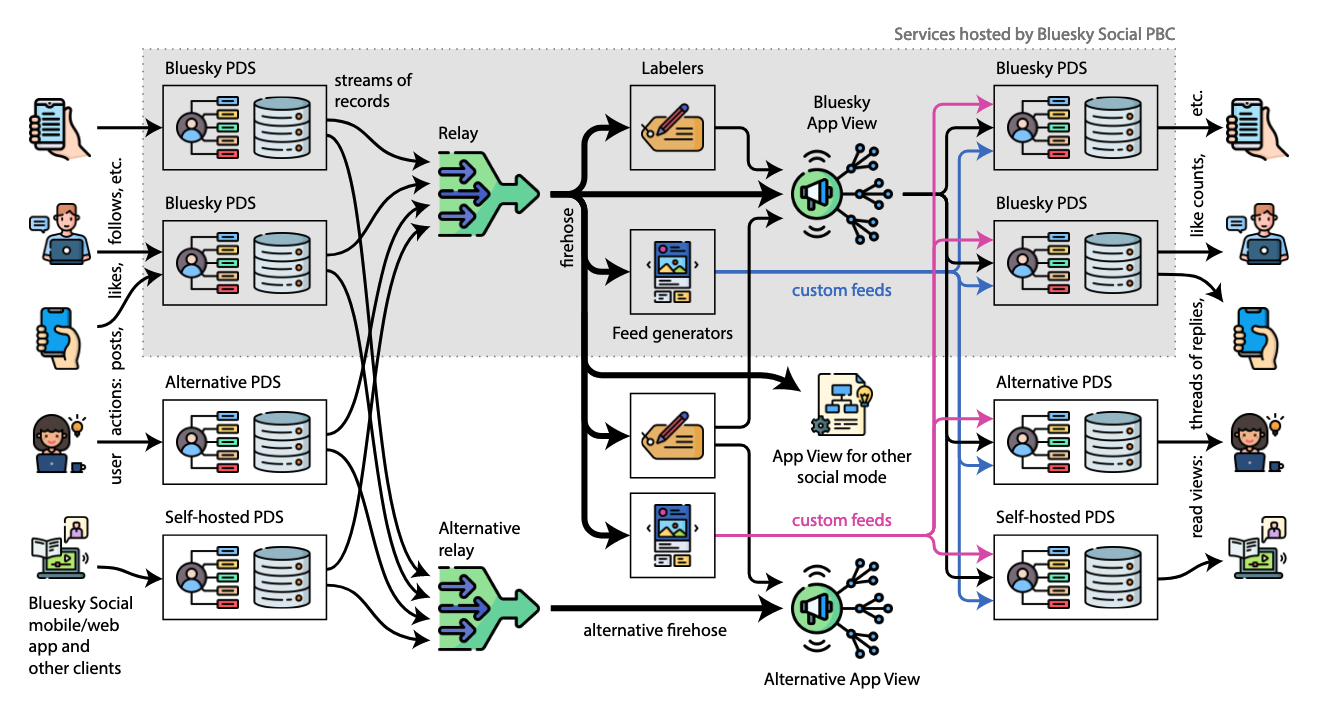
AT Protocol (Kleppmann et al., 2024) was developed by BluesSky Social, a public-benefit corporation invested by then Twitter CEO Jack Dorsey, aiming to construct a decentralized social network ecosystem that de-couples the functions of data hosting and content curation, in order to address the usability issue in fediverse, while preserving an open protocol nature.
The general architecture of AT Protocol resembles that of the Web, which itself is a decentralized system for information hosting and distribution. In AT Protocol, each user's activity records (e.g. posts, likes, follows) are saved and hosted on a Personal Data Server (PDS), which is analogous to "websites". To make these distributed data usable, the system will include multiple indexers that watch and aggregate the data from PDSes, analogous to "search engines". Just like how Google provides a slice of the Web and ranking of websites for different queries (and this different information needs), these indexers can provide either opinionated or un-opinionated content feed (feed generators), as well as content moderation based on different standards, from misinformation to outright hate speech (labelers).
Most interestingly, AT Protocol utilizes the Domain Name Services (DNS) as the distributed solution for username-user ID resolution. In addition to leveraging existing DNS infrastructure of ICANN, members of organizations with well-known domain names can also use a subdomain as username, asserting their authenticity via the inherent authority of domain name delegation hierarchy.
Decentralized Social Media's Solved & Unsolved Issues
Data Hosting
One of the driving forces of decentralized social media is the concern for centralized control of sensitive user data (Roscam Abbing et al., 2023). As a result, distributed storage and hosting of user data is a common feature across all paradigms of DOSNs, providing user more control over how their personal data are stored, processed and transported.
In fediverse, the service instance is in charge of storage and hosting of user data, and the propagation of these data are constrained by the federation network of the instance, for purposes usually no other than content sharing. Similarly, the user can freely decide the host of their personal data via the choice of PDSes, but all their activity data is public due to the current protocol limits (Kleppmann et al., 2024). Both schemes provide users with a clear mental model of how their data is being used, and who should be held accountable in the case of infringement. However, the decentralized nature of such protocols also lowers the boundary for ill-intentioned hosts to enter the ecosystem, and whether these trusted distributed server owners or service providers have the expertise to provide security guarantee remains questionable (Laux et al., 2023).
Some blockchain-based social network solutions proposes to provide security guarantee in a distributed fashion with its immutable records of user activity and user-controllable encryptions (Sarode et al., 2024)[(Jiang & Zhang, 2019)]. However, such systems, like a large portion of blockchain applications, is burdened by its poor scalability and high operation costs (Singh, 2025), compromising its practicality. A report published by the European Parliament in 2019 has also identified a tension between the immutability nature of blockchain records and the right to be forgotten regulated by GDPR (European Parliament, 2019), which is even more problematic when the records bare the details of the subjects' online social interactions. The technical complexity of blockchain applications also begs the question of how much trust it can gain from average non-tech-savvy users.
Content Discovery and Feed Generation
Due to the distributed nature of its ecosystems, implementing a data-driven feed generation algorithm is more complex in DOSNs. Microblogging fediverse applications like Mastodon usually have a reverse-chronological feed with content from the accounts one follows and on their local fediverse instance, with content discovery heavily depending on users' proactive searching and networking. This may satisfy users who was nostalgic of the simple, manipulation-free environment of early Instagram, but it also compromises the usability of federated social media, especially in a modern social media landscape characterized by precise recommendation algorithms and content discoverability (Kleppmann et al., 2024).
To enhance the quality of feeds while preserving privacy, some fediverse add-ons like RaccoonBits (Pacheco, 2025) provide local user-controllable algorithms for users, but its ability is fairly limited due to the amount of data accessible. Some blockchain-based solution moves the collective feed generation function to Ethereum smart contracts, addressing the issue in a open, distributed fashion, with a additional benefit of monetizing such work. However, such proposals only move the traditionally centralized feed algorithm function to the distributed blockchain on a technical level, without directly addressing the issue of algorithm autonomy and explainability.
Meanwhile, The AT protocol recognizes the need of an aggregated source of activity updates and a diverse profile of fed filtering and sorting services, and that it requires a widely disjoint expertise from that of data hosting (Kleppmann et al., 2024). Instead of proposing a centralized architecture, the AT protocol wishes to create a marketplace of "feed generators" in the ecosystem, each can afford different user interest and values. Such architecture could also afford the "slow media" paradigm (Noble, 2018), where human feed creators can participate freely in shaping its trusters' feed. This enables actors such as journalists in re-taking a role of shaping the public discourse using a mixture of human expertise and scalable algorithm in a trust-based, open competition manner, as suggested by Pasquale (Pasquale, 2020).
Moderation
In fediverse, the responsibility of moderation lies on the instance admin. Each instance has its own "code of conduct" (CoC), governing the content generated by the users within the instance. The modification of the CoC is often democratic, involving public discussion and voting. Since the admin of an instance is often part of the community, they are embedded in the relevant social context, thus able to make more nuanced moderation decisions. In the case of undesirable content coming from other instances, the admin also have the power to silence or de-federate the problematic instance. Under this design, users can also choose their preferred style of moderation by choosing a instance to create account on (Caelin, 2022).
It has apparent downsides as well. Researches have found that a lot of Mastodon instances are "understaffed", with the majority of instances having a single admin (Anaobi et al., 2023). The size of instances also impacts moderation quality, leading to some instances intentionally limit its membership size (Caelin, 2022). Unscalable and uncompensated, it contradicts the vision of valuing the role of journalists and fact-checkers as paid professionals participating in an automated public sphere proposed by Pasquale (Pasquale, 2020).
The AT protocol addresses the moderation issue with a similar mechanism as feed generators, delegating the job of flagging problematic content to "labelers" services, each with its own goals (e.g. curbing misinformation and filtering hate speech) and standards. Similar to feed generators, these labelers can be opinionated, and users get to decide whose judgements to trust (Kleppmann et al., 2024). This creates an opportunity for professional fact-checkers and moderators to influence the content quality at scale, while taming the concerns for censorship and manipulation. Monetization for both feed generator and labeler services will likely be done with a subscription-based fashion (Lang, 2024), although it is unclear whether such business model can effectively attract users.
Lessons Learned from Decentralized Social Media
Despite painting a seemingly bright future, we are far from the utopia envisioned by any of these decentralized social media platforms. The fediverse pales comparison in membership to any mainstream alternatives. Bluesky is still the only major social application on AT protocol, and its promise of decentralizing might still eventually lead to a centralized ecosystem, resembling the emergence of tech giants on the Web, which is the very model of distributed architecture success it wishes to replicate.
However, insights can still be drawn from the experience of decentralized social network, providing guidance for developers and lawmakers alike, in shaping a desirable automated public sphere in the current reality.
Trust-based Data Governance is Unavoidable
As evidenced in the Data Hosting section, there is no avoiding the issue of trust between the human subject and the technology. Indeed, the practice of delegating control of data is an inherently trust-based issue that no amount of distributed actors or zero-trust technology can solve.
Instead, data governance regulations such as GDPR should examine its compatibility with these emerging social network paradigms, which may soon be incorporated into mainstream social media. Issues like the above-mentioned tension between right to be forgotten and blockchain immutability, cross-border data transfer, as well as the difficulty of identifying data controller in a federated scheme of social media, should be addressed (European Parliament, 2019).
Moreover, in a future where no single party controls the majority of users' social data, data trust initiatives designed for citizens' social activity data can be considered, unlocking the beneficial data potential, while protecting the data subjects' rights of participation in data decisions (The Global Partnership on AI, 2021).
Value of Human Moderation
Although unscalable, the purely human moderation practice on Mastodon is appreciated by its users. Not only can human admins make moderation decisions embedded in the social and cultural context, they can also facilitate public discussions and democratic procedures regarding decisions about the community rules (Caelin, 2022). In essence, such constant discussion and reconsideration of social rules and common values by community members is what holds together a society (Gillespie, 2020).
To leverage "the human touch" while also be scalable, a "human-in-the-loop" collaborative mechanism should be ensured for content moderation. Past experience of collaboration between journalists and Facebook on improving the site's content qualities has seen mixed results, largely due to the tensions of different motivations and competing priorities (Ananny, 2018). Concerns have also been raised for the human reviews' wellbeing, as they are constantly exposed to explicit or brutal contents pending their reviews (Roberts, 2019). Both of these problems might be addressed with a transparent, human-centered moderation platform, which clearly reflects the interests of all parties. This platform can prioritize human review for content requiring more cultural sensitivity, and machines for those potentially scarring (Gillespie, 2020).
New regulations like the EU's Digital Services Act (DSA) have already started to require platforms to employ sufficient staff for timely moderation and ensure cultural competence among moderators. Trusted flaggers with local expertise are also being integrated into moderation workflows (European Commission, 2024). The UK's Online Safety Act emphasizes proportionality in moderation efforts based on platform size and risk profile, further incentivizing platforms to refine their human oversight mechanisms (UK Government, 2023). Similar regulations should be extended to ensure the workers' compensation and wellbeing that reflects the importance of their role in modern society.
Respecting User Autonomy
Perhaps the biggest lesson that can be drawn from decentralized social media is to respect user autonomy, and to trust that individual actors' conscious decisions can benefit society as a whole.
Decentralized social media origins as a reaction for centralized algorithmic manipulation and censorship. Its technical mechanisms do not inherently prevent the emergence of ill-intentioned actors in society, but these communities have demonstrated resilience toward these threats via collective social actions (Caelin, 2022). Fringe social media might be a refuge for extremism, but it will always exist somewhere on the Internet, no matter what the technical topology of social network is. It's the matter of how we the social members maintain a proper distance and interaction with these groups.
User autonomy can also be embodied in their conscious choice of the social content they are exposed to. By acknowledging the subjective nature of feed curation and trusting users' decisions, coupled with an easily understandable mental model, Bluesky's feed generator and labeler marketplace (Kleppmann et al., 2024) is a great example of algorithmic explainability and user autonomy. Such a trust-based relationship among users, journalists and fact-checkers could be modeled in other social media, letting these parties have a more prominent influence on the users' content consumption and interpretation.
One might be concerned about the potential of intensified echo chamber effect once users have the choice of who to trust with deciding the content they view. However, research in the field of human-computer interaction (HCI) has shown that users do consciously look for information that is outside of their comfort zones when they have the mental capacity to do so, and that such practices is essential in users' development of critical thinking (Chen et al., 2022), (Jahanbakhsh et al., 2022). The social media should afford the choice of exploring challenging contents and taking rests in comfort zones, instead of fixating a user's preference in a static algorithmic equilibrium.
Conclusion
Decentralized social media platforms offer promising solutions to the problems of centralized control, data privacy, and content moderation. While these new models empower users and encourage diverse values, they also face challenges in scalability, usability, and trust. The lessons from decentralized networks highlight the importance of user autonomy, transparent data governance, and the continued value of human moderation. As the social media landscape evolves, combining open protocols with human expertise and thoughtful regulation can help create a healthier, more democratic online public sphere.
References
Ananny, M. (2018). The partnership press: Lessons for platform-publisher collaborations as Facebook and news outlets team to fight misinformation. Columbia Journalism Review. https://www.cjr.org/tow_center_reports/partnership-press-facebook-news-outlets-team-fight-misinformation.php/
Anaobi, I. H., Raman, A., Castro, I., Zia, H. B., Ibosiola, D., & Tyson, G. (2023). Will Admins Cope? Decentralized Moderation in the Fediverse. Proceedings of the ACM Web Conference 2023, 3109–3120. https://doi.org/10.1145/3543507.3583487
Caelin, D. (2022). Decentralized Networks vs The Trolls. In H. Mahmoudi, M. H. Allen, & K. Seaman (Eds.), Fundamental Challenges to Global Peace and Security : The Future of Humanity (pp. 143–168). Springer International Publishing. https://doi.org/10.1007/978-3-030-79072-1_8
Dolan, E. W. (2024, May 2). From Twitter to Truth Social: How Trump’s shift in platforms influenced media attention. PsyPost - Psychology News. https://www.psypost.org/from-twitter-to-truth-social-how-trumps-shift-in-platforms-influenced-media-attention/
European Commission. (2024). Questions and answers on the Digital Services Act* [Text]. European Commission - European Commission. https://ec.europa.eu/commission/presscorner/detail/en/qanda_20_2348
European Parliament. (2019). Blockchain and the general data protection regulation: can distributed ledgers be squared with European data protection law? Publications Office. https://data.europa.eu/doi/10.2861/535
Gillespie, T. (2020). Content moderation, AI, and the question of scale. Big Data & Society, 7(2), 2053951720943234. https://doi.org/10.1177/2053951720943234
Hughes, C. (2019, May 9). Opinion | It’s Time to Break Up Facebook. The New York Times. https://www.nytimes.com/2019/05/09/opinion/sunday/chris-hughes-facebook-zuckerberg.html
Instagram. (n.d.). About Threads and the fediverse | Instagram Help Center. https://help.instagram.com/169559812696339
Jahanbakhsh, F., Zhang, A. X., & Karger, D. R. (2022). Leveraging Structured Trusted-Peer Assessments to Combat Misinformation. Proceedings of the ACM on Human-Computer Interaction, 6(CSCW2), 1–40. https://doi.org/10.1145/3555637
Jiang, L., & Zhang, X. (2019). BCOSN: A Blockchain-Based Decentralized Online Social Network. IEEE Transactions on Computational Social Systems, 6(6), 1454–1466. https://doi.org/10.1109/TCSS.2019.2941650
Kleppmann, M., Frazee, P., Gold, J., Graber, J., Holmgren, D., Ivy, D., Johnson, J., Newbold, B., & Volpert, J. (2024). Bluesky and the AT Protocol: Usable Decentralized Social Media. Proceedings of the ACM Conext-2024 Workshop on the Decentralization of the Internet, 1–7. https://doi.org/10.1145/3694809.3700740
Lang, K. (2024). Subscriptions and Monetization are Coming to Bluesky — Here’s How They’ll Work. Buffer: All-You-Need Social Media Toolkit for Small Businesses. https://buffer.com/resources/bluesky-subscriptions-monetization/
Laux, L., Erdődi, L., & Selgrad, K. (2023). Trust as the Elephant in the Room: Security Evaluation of Decentralized Online Social Networks with Mastodon. Norsk IKT-Konferanse for Forskning Og Utdanning, 3, Article 3. https://www.ntnu.no/ojs/index.php/nikt/article/view/5653
Noble, S. U. (2018). Algorithms of oppression: how search engines reinforce racism. New York University Press.
Pacheco, M. (2025). mahomedalid/raccoonbits [C#]. https://github.com/mahomedalid/raccoonbits (Original work published 2023)
Pasquale, F. (2020). New Laws of Robotics: Defending Human Expertise in the Age of AI. Harvard University Press. https://doi.org/10.2307/j.ctv3405w6p
Rader, E., & Gray, R. (2022). VisualBubble: Exploring How Reflection-Oriented User Experiences Affect Users’ Awareness of Their Exposure to Misinformation on Social Media. CHI Conference on Human Factors in Computing Systems Extended Abstracts, 1–7. https://doi.org/10.1145/3491101.3519615
Roberts, S. T. (2019). Behind the screen: content moderation in the shadows of social media. Yale University press.
Roscam Abbing, R., Diehm, C., & Warreth, S. (2023). Decentralised social media. Internet Policy Review, 12(1). https://doi.org/10.14763/2023.1.1681
Sarode, R. P., Watanobe, Y., & Bhalla, S. (2024). A Decentralized Blockchain Powered Social Network for Secure and Transparent Online Interactions. Proceedings of the 2023 4th Asia Service Sciences and Software Engineering Conference, 141–147. https://doi.org/10.1145/3634814.3634834
Schneider, N. (2019). Decentralization: an incomplete ambition. Journal of Cultural Economy. https://www.tandfonline.com/doi/abs/10.1080/17530350.2019.1589553
Singh, D. (2025). Exploring Blockchain Scalability and Its Impact on Adoption. Debutinfotech. https://www.debutinfotech.com/blog/what-is-blockchain-scalability
The Global Partnership on AI. (2021). Understanding data trusts. /publications/understanding-data-trusts-a-perspective-from-the-global-partnership-on-ai
UK Government. (2023). Online Safety Act: explainer. GOV.UK. https://www.gov.uk/government/publications/online-safety-act-explainer/online-safety-act-explainer
Vanian, J. (2025, April 11). Meta faces the FTC as blockbuster antitrust trial kicks off. CNBC. https://www.cnbc.com/2025/04/11/ftc-meta-instagram-whatsapp-lawsuit.html